Chapter 04 · c. 180 BCE to 750 CE
Gupta and the classical age
गुप्त और शास्त्रीय युग
After the Mauryas, power in the subcontinent was plural and regional: the Satavahanas in the Deccan; Indo-Greeks, Shakas and then the Kushans in the north-west; the Chera, Chola and Pandya kings of the Tamil country. From about 320 CE the Guptas built the largest state of the fourth and fifth centuries, centred on the Ganga plain. The same centuries produced Aryabhata's astronomy, the monastery at Nalanda, the Ajanta paintings under Vakataka patrons and, on most scholars' dating, Kalidasa's poetry. In the seventh century Harsha ruled much of the north from Kannauj while the Chalukyas of Badami and the Pallavas of Kanchi contested the south.
The outline is the Gupta empire near its widest, under Chandragupta II around 400 to 415 CE, after the defeat of the western Kshatrapas brought Malwa and Gujarat under Gupta rule. It is approximate. Samudragupta's inscription on the Allahabad pillar describes rings of kings who were uprooted, captured and released, or made to pay tribute, not a border; the line drawn here is the zone of direct rule and leaves the tributaries outside.
Events in this chapter
100 BCE – 250 CE ±100 · Madurai, Tamil Nadu
Sangam poetry and the Tamil kings
Tamil poets of love and war compose the Sangam anthologies under the Chera, Chola and Pandya kings, while Roman ships trade at Muziris and Arikamedu.
106 CE – 130 CE ±50 · Pandavleni caves, Nashik, Maharashtra
Gautamiputra Satakarni and the Nashik caves
A queen mother's inscription at Nashik praises her son Gautamiputra Satakarni for crushing the Shakas and restoring Satavahana power.
127 CE – 150 CE ±5 · Mathura, Uttar Pradesh
Kanishka and the first Buddha images
Kanishka's Kushan empire joins Bactria to the Ganga plain; at Mathura and in Gandhara sculptors make some of the earliest images of the Buddha.
319 CE – 320 CE · Pataliputra (Patna), Bihar
Chandragupta I and the Gupta era
The Gupta era begins in 319-320 CE, most likely with Chandragupta I's accession; coins show his marriage to a Licchavi princess.
350 CE – 375 CE ±15 · Allahabad Fort, Prayagraj, Uttar Pradesh
Samudragupta's Allahabad pillar
Harishena's Sanskrit eulogy on an Ashokan pillar lists the kings Samudragupta uprooted, the southern kings he freed, and the tributaries beyond.
415 CE – 455 CE ±10 · Nalanda, Bihar
Nalanda mahavihara
A monastery founded under Kumaragupta I grows into a Buddhist university that draws scholars from China, Korea and Tibet until the 13th century.
460 CE – 480 CE ±20 · Ajanta caves, Maharashtra
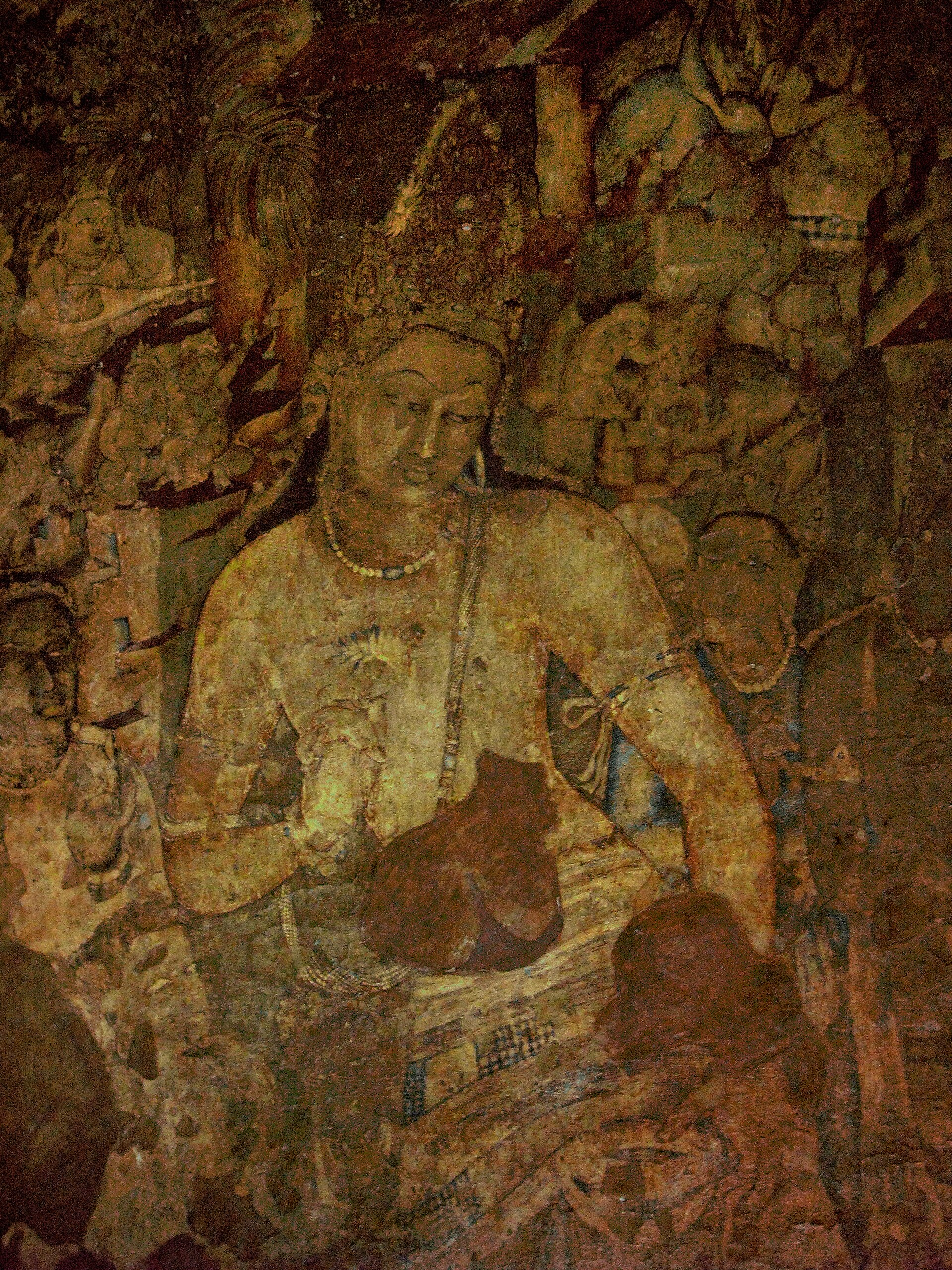
The painted caves of Ajanta
Under the Vakataka king Harishena, monks and courtiers cut new caves above the Waghora and paint them with the Jataka stories.
499 CE · Kusumapura, identified with Pataliputra (Patna), Bihar
Aryabhata writes the Aryabhatiya
At twenty-three, Aryabhata completes a compact Sanskrit treatise on mathematics and astronomy, with a value of pi and a rotating Earth.
606 CE – 647 CE · Kannauj, Uttar Pradesh
Harsha's Kannauj
Harshavardhana rules the north from Kannauj, is turned back at the Narmada by Pulakeshin II, and hosts the Chinese pilgrim Xuanzang.
630 CE – 728 CE ±10 · Shore Temple, Mamallapuram, Tamil Nadu
Pallava Mamallapuram
At the Pallava port east of Kanchipuram, granite is cut into cave shrines, monolithic rathas and a vast relief, and the Shore Temple rises by the sea.